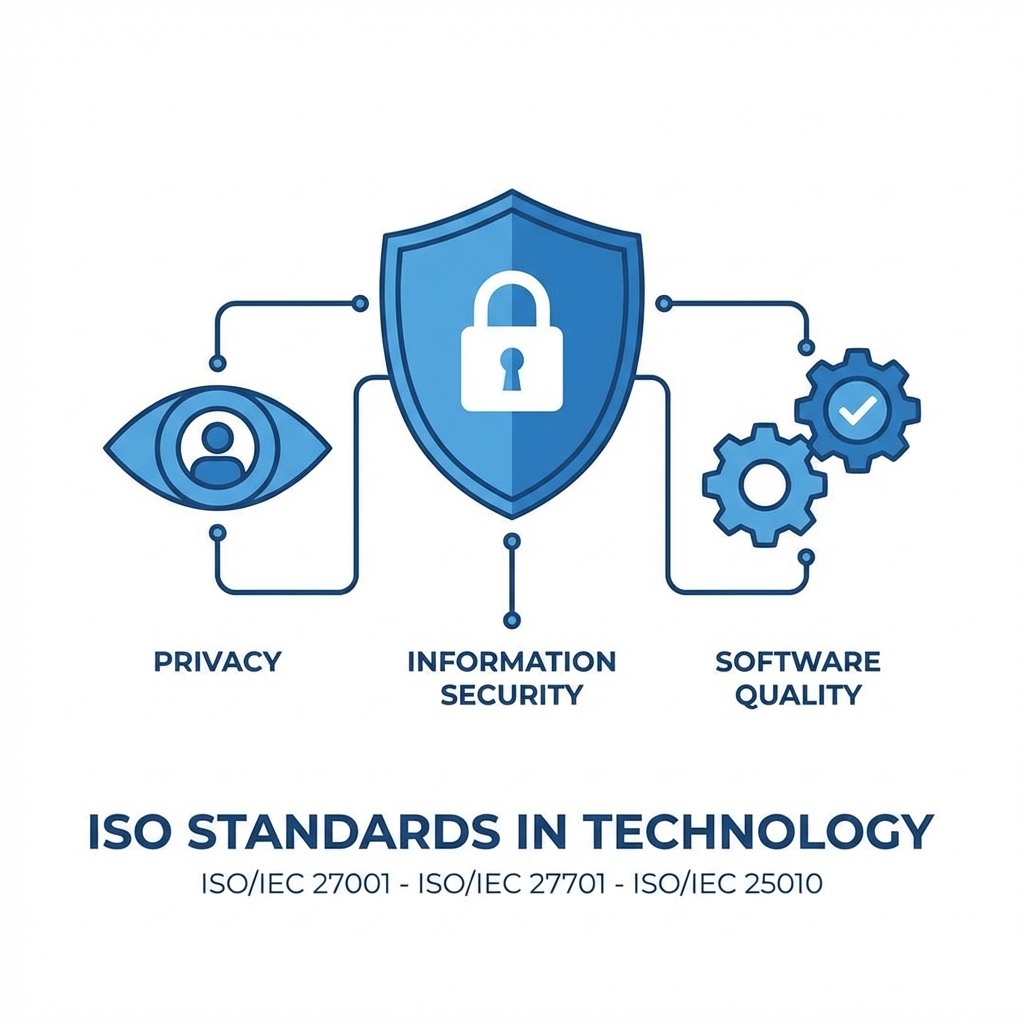
Understanding ISO Standards: 27001, 27701, and 25010
In the rapidly evolving landscape of digital technology, adhering to international standards is crucial for organizations to ensure security, privacy, and quality. Three key standards—ISO 27001, ISO 27701, and ISO 25010—provide robust frameworks for these goals.
ISO 27001: Information Security Management
ISO/IEC 27001 is the leading international standard for Information Security Management Systems (ISMS). It provides a systematic approach to managing sensitive company information so that it remains secure. It includes people, processes, and IT systems by applying a risk management process.
The core of ISO 27001 is the CIA Triad:
- Confidentiality: Ensuring that information is accessible only to those authorized to have access.
- Integrity: Safeguarding the accuracy and completeness of information and processing methods.
- Availability: Ensuring that authorized users have access to information and associated assets when required.
ISO 27701: Privacy Information Management
ISO/IEC 27701 serves as an extension to ISO 27001 and ISO 27002 for privacy management within the context of the organization. It outlines the requirements for establishing, implementing, maintaining, and continually improving a Privacy Information Management System (PIMS).
While ISO 27001 focuses on security, ISO 27701 bridges the gap between information security and data privacy. It is designed to help organizations comply with privacy regulations such as the GDPR (General Data Protection Regulation) and various local privacy laws.
ISO 25010: Software Quality Models
ISO/IEC 25010 describes a quality model for computer systems and software products. It defines eight main characteristics of software quality:
- Functional Suitability: Degree to which the product provides functions that meet stated and implied needs.
- Performance Efficiency: Relationship between the level of performance and the amount of resources used.
- Compatibility: Degree to which a product, system, or component can exchange information with other products.
- Usability: Degree to which a product or system is effective, efficient, and satisfactory for specified users.
- Reliability: Degree to which a system, product, or component performs specified functions under specified conditions.
- Security: Degree to which a product or system protects information and data.
- Maintainability: Degree of effectiveness and efficiency with which a product or system can be modified.
- Portability: Degree of effectiveness and efficiency with which a system, product, or component can be transferred from one hardware, software, or other operational or usage environment to another.
Real-World Implementation in Indonesia
Indonesian companies are increasingly adopting these standards to build trust and ensure compliance with global and local regulations.
Credit Bureau Indonesia (CBI)
Credit Bureau Indonesia (CBI) is a prime example of commitment to these standards. They are the first private credit bureau in Indonesia to achieve ISO 27701 certification. This certification complements their existing ISO 27001 ISMS, demonstrating a comprehensive approach where security meets privacy—a critical necessity in the financial sector where sensitive personal data is handled daily.
PrivyID
PrivyID (PT Privy Identitas Digital) was the first Indonesian startup to obtain ISO/IEC 27001:2013 certification. As a digital identity provider, security is their core product offering. Achieving this standard early on helped establish them as a trusted partner for digital signatures and identity verification in Indonesia.
Enterprise Adoption: GoTo, BCA, BRI
Major enterprises like GoTo (Gojek Tokopedia), Bank Central Asia (BCA), and Bank Rakyat Indonesia (BRI) have also adopted ISO 27001. For these giants, managing the data of resident millions requires a rigid framework to prevent breaches and maintain customer trust. The adoption of ISMS ensures that their massive ecosystems remain resilient against cyber threats.
How to Prove Compliance?
If stakeholders, clients, or partners ask whether your application adheres to these standards, the method of proof varies by standard:
ISO 27001 and ISO 27701 (Process & Management)
The gold standard for proving compliance with ISO 27001 and ISO 27701 is Formal Certification.
- External Audit: You must hire an accredited certification body (e.g., BSI, SGS, TÜV) to audit your organization.
- Certificate: Upon passing the audit, you receive a formal certificate valid for a specific period (usually 3 years), subject to surveillance audits.
- Scope Statement: The certificate defines the "Scope of Registration," detailing exactly which parts of your organization or products are covered.
ISO 25010 (Product Quality)
ISO 25010 is a quality model for the software product itself, not a management system. Therefore, you typically don't get an "ISO 25010 Certificate" for the company. Proof usually comes in the form of:
- Independent Verification & Validation (IV&V) Report: A third-party testing lab evaluates your software against the ISO 25010 characteristics.
- Test Reports: Detailed documentation showing testing methodologies and results for performance, security, usability, etc., mapped to ISO 25010 criteria.
- Statement of Conformance: A formal declaration issued by an independent evaluator stating the software meets specific quality requirements defined in the standard.
Conclusion
Understanding and implementing standards like ISO 27001, 27701, and 25010 is not just about compliance; it's about building a resilient foundation for your technology. Whether it's securing data (27001), protecting privacy (27701), or ensuring robust software quality (25010), these frameworks provide the blueprints for excellence in the digital age.